Critical remote code execution flaw in Apache Roller actively exploited
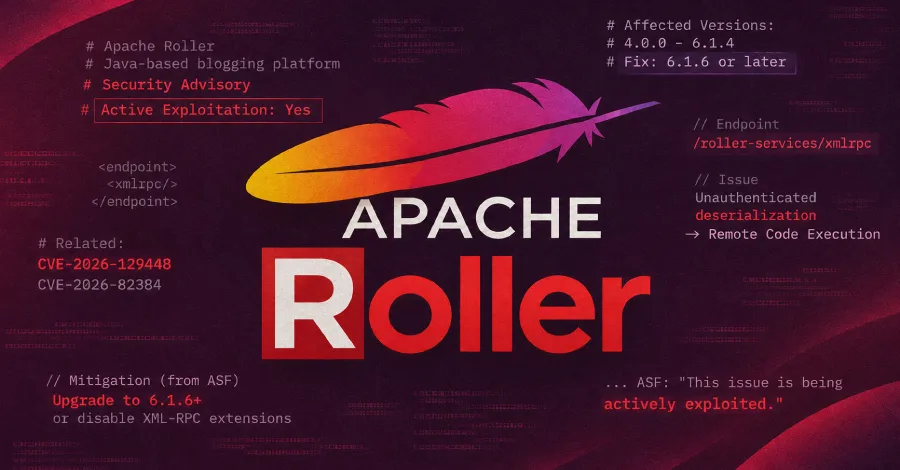
The vulnerability CVE-2026-129448 affects the Apache Roller platform, allowing unauthenticated remote code execution via the XML-RPC endpoint.
Critical remote code execution flaw in Apache Roller is actively exploited
The Apache Software Foundation (ASF) has issued an urgent alert about a critical security vulnerability affecting Apache Roller, a popular open-source Java blogging platform. The flaw, tracked under identifier CVE-2026-129448 with a maximum CVSS severity score of 9.8, is being actively exploited in real-world cyber attacks in the threat landscape.
The attack vector lies in the improper handling of unsafe deserialization of untrusted data within the application's XML-RPC endpoint. According to the project maintainers, the endpoint accepts vendor extension types and performs deserialization before even authenticating the requester's identity, paving the way for remote, unprivileged attackers to execute arbitrary commands on the target server.
Affected version scope and relation to previous vulnerability
There are minor discrepancies in technical documentation and public vulnerability databases regarding the upper bound of affected versions. While the NIST NVD, Security Affairs, and Bleeping Computer indicate that the flaw affects versions 4.0.0 through 6.1.4, specialized analyses such as Tuskira AI suggest the scope may extend up to version 6.1.5.
The ASF clarified that this new CVE is directly related to CVE-2026-82384, a flaw disclosed earlier in September 2026 that dealt with the same improper deserialization mechanism in the XML-RPC endpoint, but initially listed only version 6.1.5 as impacted. The issue stems from the unconditional servlet mapping, causing request analysis and deserialization to occur even if the global XML-RPC feature is disabled in the administration interface.
Mitigation recommendations and immediate action plan
The top priority recommendation from the Apache Software Foundation is to immediately upgrade Apache Roller to version 6.1.6 or later, which mitigates the issue by disabling inappropriate extension types and rejecting requests when the XML-RPC feature is disabled.
For administrators who cannot apply the patch immediately, the foundation suggests manual mitigation measures. It is necessary to set the parameter enabledForExtensions to false in the WEB-INF/web.xml file or completely remove the servlet mapping /roller-services/xmlrpc, then restart the application. The entity emphasizes that disabling XML-RPC solely via the graphical administration interface is insufficient, as vulnerable versions process the request before checking that setting.
CyberX Technical Analysis
The vulnerability CVE-2026-129448 exposes a classic architectural flaw in Java applications that use XML-RPC–based endpoints without prior authentication validation. The unsafe deserialization mechanism triggered by the endpoint accepts arbitrary objects supplied by the client, allowing injection of known classpath gadgets capable of manipulating the execution flow and resulting in Remote Code Execution (RCE).
Exposure surface and exploitation conditions
The exposure surface includes any server running vulnerable Apache Roller instances exposed to the internet or internal networks with access to the XML-RPC endpoint (typically mapped at /roller-services/xmlrpc). Since the exploit does not require valid credentials and is independent of complex non‑default configurations (as the servlet mapping occurs unconditionally), any malicious actor can trigger payloads automatically.
Advanced mitigation and defensive validation
Security teams should audit corporate assets to inventory Apache Roller instances. If upgrading to version 6.1.6 is not feasible in the short term, manually editing the web.xml file and physically removing the servlet mapping are highly recommended to block the exploited execution path in ongoing attacks.
CyberX SOC Intelligence Bulletin
SOC monitoring should focus on identifying HTTP requests targeting Apache Roller's XML‑RPC endpoints, evaluating anomalous traffic patterns and code execution attempts from unauthenticated IPs. No specific Indicators of Compromise (IoCs) or details about the threat groups behind the active attacks have been disclosed.
Investigation signs and recommended telemetry
- Inspect application server access logs (Tomcat or equivalent container) for frequent or large POST requests directed at
/roller-services/xmlrpc. - Check for abruptly spawned child processes from the Roller server's Java process, which may indicate successful shell command execution.
- Audit the integrity of configuration files, especially
WEB-INF/web.xml, to detect unauthorized modifications.
MITRE ATT&CK Mapping
- TA0001 (Initial Access) / T1190 (Exploit Public-Facing Application): Exploiting the unprotected XML‑RPC endpoint for initial entry.
- TA0002 (Execution) / T1203 (Exploitation for Client Execution): Unsafe deserialization resulting in arbitrary code execution.
Frequently Asked Questions
What is CVE-2026-129448?
It is a critical security vulnerability affecting Apache Roller that allows unauthenticated remote code execution via the XML-RPC endpoint.
Which versions of Apache Roller are affected?
Documentation indicates versions 4.0.0 through 6.1.4 are affected, with specialized analyses suggesting the scope may extend up to version 6.1.5.
How can administrators mitigate this vulnerability?
Administrators should immediately upgrade to version 6.1.6 or later, or manually set the parameter enabledForExtensions to false in the WEB-INF/web.xml file and remove the servlet mapping.