TPM Firmware Flaw Reduces PIN Cracking Time on AMD and Intel PCs
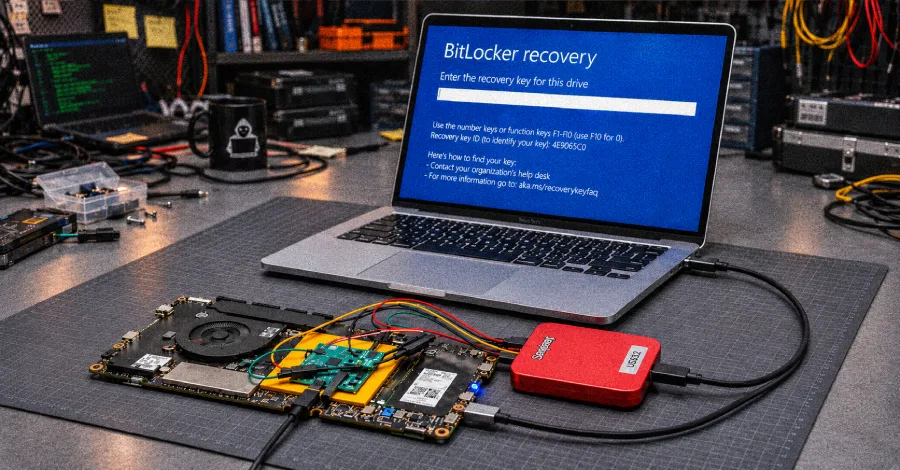
Researchers demonstrate that, by opening a PC's case, it is possible to rewrite the TPM state and bypass the PIN attempt lockout in Windows Hello and BitLocker, reducing the time to discover PINs from years to days.
TPM firmware flaw allows attackers to reset failure counters on AMD and Intel PCs, reducing PIN cracking time from days to hours.
Researchers at the Technical University of Berlin demonstrated that, by opening a PC's case, it is possible to rewrite the TPM state and bypass the PIN attempt lockout in Windows Hello and BitLocker, allowing four- and six-digit PINs to be discovered in less than 40 hours.
The flaw, cataloged as CVE‑2026‑43613, affects AMD processors that use RPMC counters in Winbond flash memory chips, as well as Intel PCs that rely on Winbond chips with a voltage‑glitch vulnerability.
The researchers built an interposer board that blocks the failure‑counter update in flash, causing the PC to reload the TPM's previous state. In tests, they found a four‑digit PIN on an AMD laptop in 236 attempts, in 57 minutes, and a six‑digit PIN on an Intel laptop in 6 minutes and 55 seconds.
With the count lock disabled, PIN discovery time drops from years to days, exposing devices to physical brute‑force attacks.
AMD confirmed the flaw and plans firmware fixes between November 2026 and February 2027 for most Ryzen, Ryzen AI, Ryzen Threadripper, Athlon, and EPYC chips. Intel stated that there is no vulnerability in its processor, but acknowledged the flaw in the memory chip.
Microsoft assessed the incident as moderate severity, did not assign a CVE, and recommended increasing the minimum PIN length to six digits.
Administrators can raise the minimum PIN length policy for Hello and BitLocker, enable enhanced PINs with letters and symbols, and install AMD firmware updates when available. PCs that rely on Winbond chips still have no fix, requiring monitoring for interposer signals.
The discovery highlights the importance of robust physical and firmware controls to protect devices that rely on embedded TPMs.
CyberX Technical Analysis
The attack exploits the lack of RPMC counter increment verification in AMD processor firmware. When the counter does not increase, the TPM's previous state, which includes the number of failed attempts, can be reloaded, nullifying the 32‑attempt lockout. The interposer board blocks writes to flash, while the voltage‑glitch flaw in Winbond chips allows extraction of the counter's signing key, enabling arbitrary value forgery.
For systems that do not use RPMC, simply rewriting the old state with a conventional flash programmer already restores the counter, indicating that protection relies solely on firmware.
The impact is primarily on confidentiality, as PIN cracking enables physical access to encrypted content and, in some scenarios, Hello‑based authentication. Availability is not affected, but the integrity of the lockout mechanism is compromised.
Recommended mitigations include: updating AMD firmware when available; enforcing PIN policies of at least six digits; enabling enhanced PINs with alphanumeric characters; monitoring Winbond devices for glitch signals; and, in critical environments, restricting physical access.
CyberX SOC Intelligence Bulletin
This vulnerability allows attackers with physical access to a PC to rewrite the TPM state, nullifying the PIN attempt lockout in Windows Hello and BitLocker. The effect is a reduction of PIN discovery time from years to days, exposing devices to brute‑force attacks.
Assets and Exposure Conditions
PCs with AMD processors that use RPMC counters in Winbond chips and Intel PCs that rely on vulnerable Winbond chips. The flaw requires physical access to the case.
Investigation Indicators
TPM logs showing failure count unexpectedly reset; PIN lockout failures without delay; repeated authentication failures in a short interval.
Mitigations and Response
Update AMD firmware per security bulletin; enforce PIN policies of at least six digits; enable enhanced PINs; monitor Winbond devices; restrict physical access.
Frequently Asked Questions
Which processors are affected by the TPM firmware flaw?
The flaw affects AMD processors using RPMC counters in Winbond flash memory chips and Intel PCs relying on Winbond chips with a voltage-glitch vulnerability.
How do attackers bypass the PIN lockout?
Attackers use an interposer board to block failure-counter updates in flash, causing the PC to reload the TPM's previous state and nullify the lockout.
What is the recommended mitigation for this vulnerability?
Administrators should update AMD firmware, enforce a minimum six-digit PIN length, enable enhanced PINs, and monitor Winbond devices for glitch signals.
Does Intel acknowledge a vulnerability in its processors?
Intel stated there is no vulnerability in its processor but acknowledged the flaw in the Winbond memory chip.