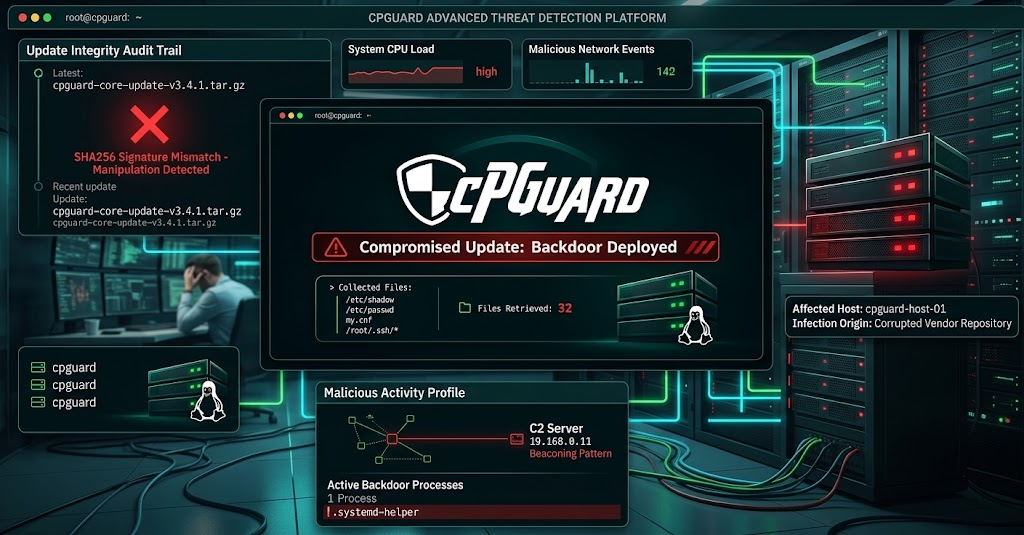
Critical APT flaw allows Man-in-the-Middle attacks and root code execution on Debian and Ubuntu
Vulnerability CVE-2026-109518 allows attackers to intercept package downloads and replace legitimate files with malicious versions, compromising Linux systems with administrative privileges.
Debian, Ubuntu, and APT researchers and developers have disclosed a security vulnerability in the Advanced Package Tool (APT), the tool responsible for package management and installation in Linux distributions.
Identified as CVE-2026-109518, the flaw allows an attacker positioned between the victim's system and the package server to manipulate the download process, replacing legitimate files with attacker-controlled content.
The issue is particularly concerning because exploitation can result in arbitrary code execution with root privileges, granting the attacker administrative control over the compromised system.
What happened
The vulnerability is related to the improper handling of files during the resumption of HTTP downloads and APT's automatic retry behavior for transfers.
Under certain conditions, the manager can reuse hard links and combine distinct downloads following HTTP redirects, compromising the package verification mechanism.
In practice, an attacker capable of manipulating traffic between the APT client and the distribution server can use redirects and temporary error responses to trigger download retries.
This behavior creates an opportunity to replace a previously verified package with another containing malicious code.
Because packages are installed with administrative privileges, execution of the compromised content can occur as root.
Technical analysis
Exploitation relies on a few specific conditions:
The attacker must be able to manipulate traffic between the client and the package server.
APT must follow HTTP redirects.
The
Acquire::Retriesconfiguration must be enabled with a non-zero value.The package installation process must occur for the malicious content to be executed.
An important detail is that the automatic retry behavior became enabled by default starting with APT 2.3.2, present in generations associated with Debian 12 and Ubuntu 22.04.
The issue does not represent a generic remote code execution flaw on any Linux machine. Exploitation depends on the attacker's position in the communication path and the specific conditions of package transfer.
Affected systems
The vulnerability affects distributions running vulnerable versions of APT, including Debian, Ubuntu, and derivative systems.
Identified versions include:
Debian
Debian 12 Bookworm: fixed in version 2.6.2.
Debian 13 Trixie: fixed in version 3.0.4.
Debian Testing: version 3.3.5 identified as vulnerable at the time of disclosure.
Debian 11 Bullseye: fix available in version 2.2.5.
Ubuntu
Ubuntu 26.10: fixed in version 3.3.3ubuntu0.1.
Ubuntu 26.04 LTS: fixed in version 3.2.1ubuntu0.1.
Ubuntu 24.04 LTS: fixed in version 2.8.4ubuntu0.1.
Ubuntu 22.04 LTS: fixed in version 2.4.15ubuntu0.1.
Ubuntu 20.04 LTS: fix available via Ubuntu Pro.
Ubuntu 18.04 LTS: fix available via Ubuntu Pro.
Ubuntu 16.04 LTS: fix available via Ubuntu Pro.
Ubuntu 14.04 LTS: fix available via Ubuntu Pro.
Fixed versions should be confirmed in each distribution's official repositories prior to deployment.
Impact on enterprise environments
Successful exploitation can directly compromise the integrity and security of Linux servers.
Key risks include:
Malicious code execution with administrative privileges.
Compromise of servers hosting enterprise applications.
Installation of malicious components during legitimate updates.
Potential alteration of system files and configurations.
Exposure of information stored on servers.
Compromise of infrastructure environments and dependent services.
In enterprise environments, the risk warrants special attention on servers that perform automated updates via proxies, mirrors, or internal repositories.
CyberX Analysis
The vulnerability highlights an important aspect of Linux infrastructure security: trust in the package update process.
APT is a core component for maintaining Debian and Ubuntu servers. As such, a flaw that allows bypassing file integrity during the installation process poses a significant risk to enterprise environments.
A particularly concerning scenario involves servers using mirror repositories, HTTP proxies, or automated update mechanisms.
Should an attacker manage to manipulate communication during an installation, they could introduce malicious content into a process that administrators typically consider trusted.
Another relevant point is the possibility that custom configurations expand the exposure of legacy systems that originally would not use automatic download retries.
For infrastructure and security teams, the recommendation is to treat update management as part of the attack surface, rather than just an operational activity.
Security recommendations
CyberX recommends that Linux system administrators prioritize the following measures:
Immediate APT update
Verify the installed version and apply the security updates released by the respective maintainers.
Configuration audit
Check for the presence of the Acquire::Retries directive in APT configuration files, especially on legacy systems that have received customizations.
Repository review
Validate the source of used packages, prioritizing official repositories and trusted mirrors.
Communication protection
Prioritize package sources using HTTPS and review the configuration of proxies and intermediate communication mechanisms.
Monitoring
Analyze installation logs, repeated download attempts, unexpected redirects, and suspicious changes made during APT operations.
Vulnerability management
Include APT package verification in the periodic vulnerability management process for Linux servers.
Indicators of compromise
To date, the consulted advisories do not present specific indicators of compromise associated with the exploitation of this vulnerability.
The absence of published IoCs does not mean that exploitation attempts cannot exist.
Conclusion
CVE-2026-109518 demonstrates how flaws in fundamental operating system components can compromise mechanisms considered reliable, such as update management and installation.
Although exploitation depends on specific network and configuration conditions, the possibility of code execution with root privileges makes the vulnerability especially relevant for infrastructure administrators.
Applying official patches, reviewing APT configurations, and validating the repositories used should be treated as priorities for organizations maintaining Debian and Ubuntu servers.
Frequently asked questions
What is the CVE-2026-109518 vulnerability in APT?
It is a security flaw in the Advanced Package Tool that allows the interception and manipulation of package downloads, potentially leading to arbitrary code execution with root privileges.
Which operating systems are affected by the APT flaw?
The vulnerability affects Linux distributions that use vulnerable versions of APT, including Debian, Ubuntu, and derivative systems.
How does the exploitation of this vulnerability work?
An attacker positioned between the client and the package server uses HTTP redirects and temporary errors to trigger new download attempts, replacing legitimate packages with malicious files.
What measures should be taken to mitigate the flaw?
Organizations must immediately update APT, audit the Acquire::Retries directive configurations, prioritize repositories using HTTPS, and monitor installation logs.