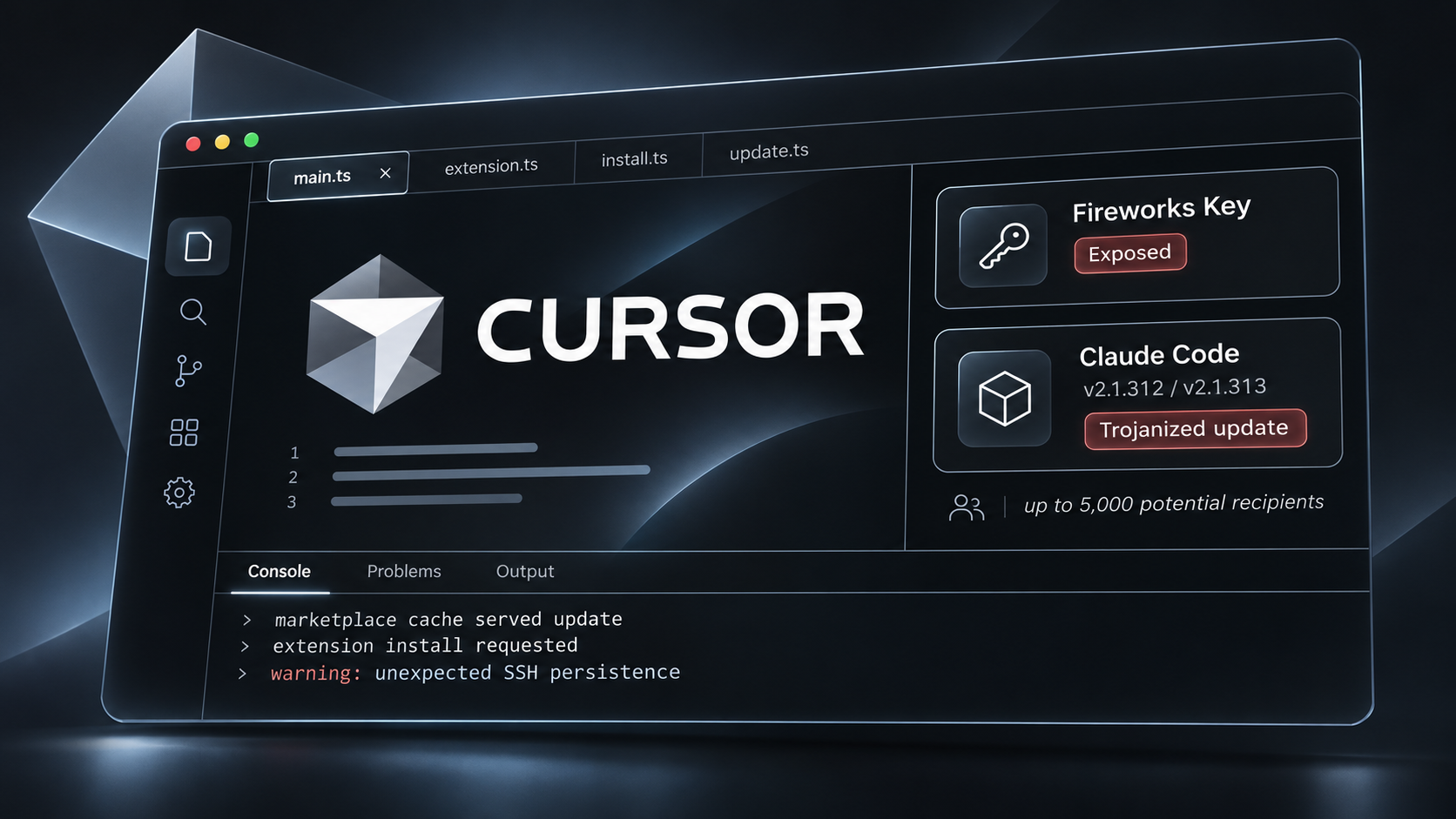
Cursor's Claude Code Extension Compromised Following Leaked Fireworks AI Key
An attacker used an access key exposed by Fireworks AI to distribute a trojanized version of the Claude Code extension on the Cursor marketplace, affecting up to 5,000 users.
AI-based development platform Cursor confirmed that the official Claude Code extension, developed by Anthropic, was trojanized and distributed through its marketplace following the theft of an access key exposed in an incident involving Fireworks AI.
How the access key was compromised
In October 2026, Fireworks AI suffered a leak that exposed API keys issued to partners. One of these keys had been granted to Cursor so the company could share coding session data in a read-only storage bucket. The attacker obtained the key, accessed the bucket, and copied data containing code snippets and, in some cases, API credentials from less than 0.01% of customers.
These credentials were used as a launching point to access SaaS services linked to Cursor, enabling the exfiltration of non-production code repositories, usage metrics, support conversations, and other limited information.
The key exploitation was detected by Cursor's security team, which immediately revoked Fireworks' access and initiated an internal investigation.
Attack flow
The attacker used the obtained credentials to insert a modified version of the Claude Code extension into the cache that feeds Cursor's marketplace. This version contained a persistent SSH backdoor, which would be installed on the systems of users who downloaded it.
The attack occurred on October 29, 2026, when up to 5,000 users who requested the specific extension received the malicious build. The package remained available for about 11 hours before being removed.
Distribution of the trojanized extension
The compromised extension was identified in versions 2.1.312 and 2.1.313, made available as legitimate updates on Cursor's marketplace. Users who installed these versions were exposed to the backdoor, which could grant remote access to the attacker.
The company reported that there is no evidence of additional malicious activity after November 1, 2026, and that users who enabled privacy mode—which prevents the collection of session data for training—were not affected.
Cursor's response
Following the discovery, Cursor took the following measures: disabled the Fireworks access key, revoked and rotated all compromised credentials, temporarily disabled internal services and the marketplace, and worked with the cloud provider hosting the attacker's server to shut down the malicious infrastructure.
The company notified affected users, assisted with the revocation of exposed credentials, and migrated all inference traffic away from Fireworks AI, eliminating reliance on the compromised key.
Broader impact and related incidents
The same Fireworks AI leak was also associated with incidents at other organizations. Uber revealed that unknown actors stole driver information by obtaining internal credentials from a vendor, identified by the press as Fireworks AI. In addition, productivity startup Notion confirmed that its data was compromised in the same attack.
These cases highlight the risk chain that can extend to multiple partners when API keys are exposed in shared cloud environments.
Recommendations for users and administrators
To mitigate similar risks, CyberX recommends the following actions:
Review and limit the scope of API keys granted to partners, adopting the principle of least privilege.
Enable privacy mode in development tools that offer this option.
Monitor access logs for storage buckets, especially those marked as read-only.
Implement integrity checks for extensions and plugins prior to installation, using digital signatures when available.
Establish rapid credential rotation processes upon detecting leaks.
Organizations using the Claude Code extension or other Cursor components should update to versions later than 2.1.313, which already remove the malicious code, and review any credentials that may have been exposed.
Frequently asked questions
How did the compromise of the Claude Code extension occur?
An attacker used an API key exposed in a Fireworks AI leak to access Cursor data and inject a modified version of the Claude Code extension with an SSH backdoor into the marketplace.
Which versions of the Claude Code extension were affected?
The affected versions were 2.1.312 and 2.1.313, made available on Cursor's marketplace on October 29, 2026.
How many users were impacted by the incident?
Up to 5,000 users who requested the extension received the malicious build during the 11 hours the package remained available.
What measures did Cursor take to contain the attack?
Cursor disabled the Fireworks AI key, revoked and rotated compromised credentials, temporarily disabled the marketplace, and migrated all inference traffic away from Fireworks AI.


