Superhuman expands Go assistant to Docs, Mail, and third‑party integrations
Superhuman launches the Go AI assistant across its entire suite, including Docs, Mail, and 20 new agents, promising personalized suggestions and proactive automation.
Superhuman transforms the Go AI assistant into a central agent that operates across documents, email, and dozens of external tools.
Superhuman, the productivity company that previously operated under the Grammarly brand, announced on Tuesday (11/19/2026) the expansion of its AI assistant, Go, to all major platform products, including Docs and Mail, in addition to integrating 20 new third-party agents via the Go SDK.
Go reaches all corners of the suite
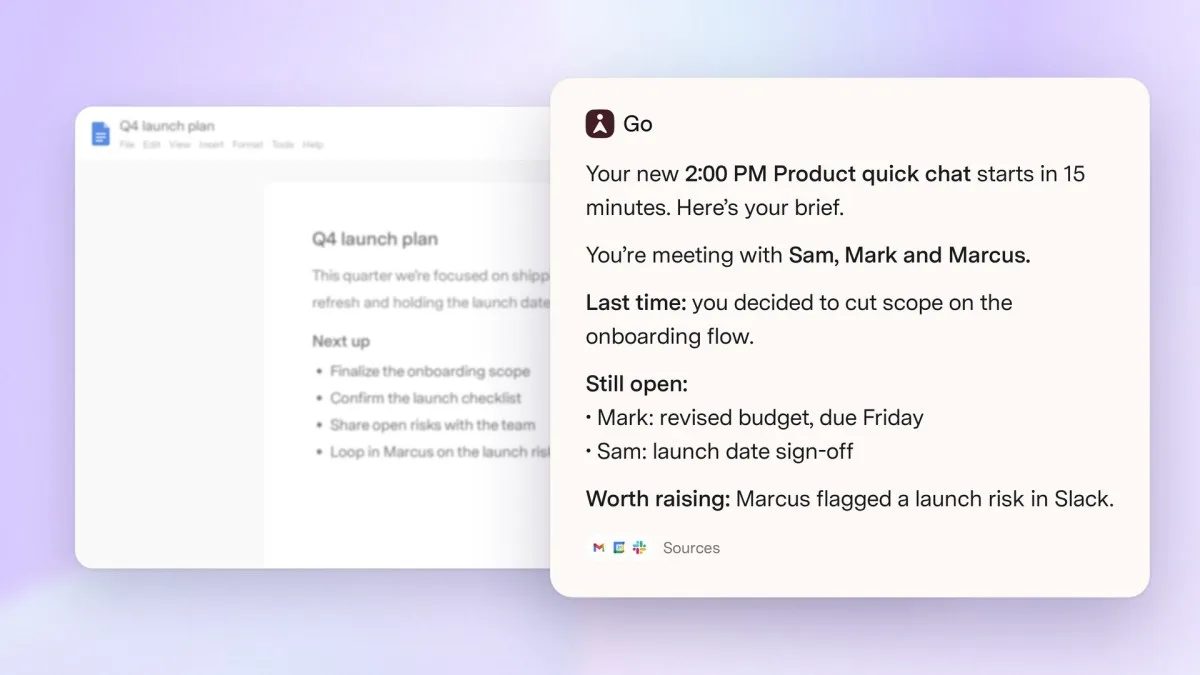
With the new deployment, Go now learns context from different applications, offering personalized prompt suggestions and responses. The assistant works “inline” next to the cursor – similar to what Grammarly does – and can manage other agents simultaneously. The company is also making Go proactive: it checks calendars, monitors the inbox, and can draft responses automatically.
New integrations and functionalities
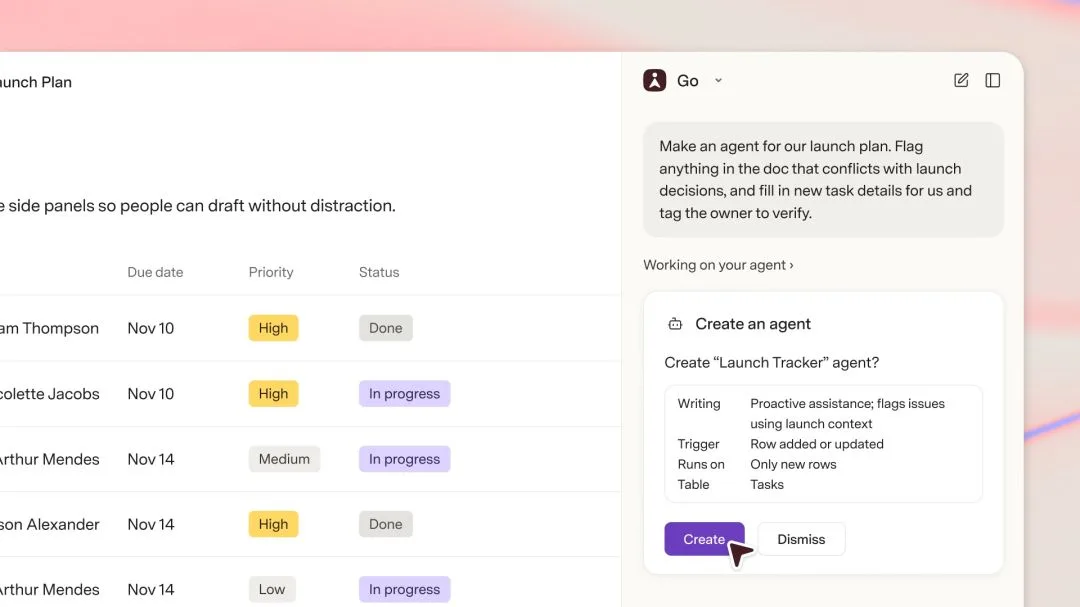
The Go SDK allows connection with external agents, and Superhuman has already announced 20 partners, including DeepL, Legora, Amplitude, Databricks, and Blackboard. In the Docs and Mail areas, Go agents operate natively, and can be triggered for background tasks or for routines that initiate event-based workflows. The company also introduced enterprise search that aggregates data from knowledge bases and connected tools, facilitating the creation of drafts and the organization of inboxes in Google and Outlook accounts.
In September, Superhuman acquired the annotation startup Fathom, expanding its context capture capability. The new live collaborative annotation feature will be shared among teams, and Go will be able to generate post-meeting decisions, such as initial drafts of proposals.
According to CEO Shishir Mehrotra, Go already has over one million active users. He highlights that, although the assistant is work-focused, it can also assist with personal tasks, such as calendar management and private emails.
“These assistants are popular because they treat the user as a whole, covering both professional and personal demands,” Mehrotra told TechCrunch.
Superhuman positions Go as an alternative to other AI assistant solutions, such as Instinct, Muse, OpenAI Dots, and Claude Duet, aiming for users to choose its platform to centralize AI-based productivity.
CyberX Technical Analysis
Superhuman's Go assistant functions as an AI agent that receives context from multiple sources – documents, email, calendars, and third-party integrations – and generates automated responses or actions. While the exact architecture has not been disclosed, the description indicates a cloud-hosted language model that receives data via APIs from connected applications. Each external agent (e.g., DeepL or Databricks) likely exposes an endpoint that Go invokes, allowing the data flow to cross different trust boundaries.
Key risk vectors:
- Sensitive data exposure: By sharing email, document, and calendar context with Go, confidential information may be transmitted to Superhuman servers and, potentially, to external agent providers.
- Third-party dependency: The integration of 20 agents increases the attack surface, as vulnerabilities in any connected service can be exploited to inject malicious data or gain unauthorized access.
- Automatic content generation: Responses and drafts produced by Go can be used in internal phishing attacks if there is no human review.
- Context persistence: Storing conversation and document history can create a valuable repository for malicious actors in case of account compromise.
Defensive recommendations:
- Implement data retention and encryption-at-rest policies for all flows passing through Go.
- Apply least-privilege access control for each connected agent, limiting API scopes.
- Enable human review for critical messages automatically generated before sending.
- Monitor Go SDK call logs and external agent APIs for anomalous patterns, such as unexpected volume or unusual destinations.
- Conduct privacy and compliance assessments (e.g., GDPR, LGPD) to ensure context sharing aligns with regulatory requirements.
To date, there is no public evidence of active exploitation or known vulnerabilities in the Go assistant.
CyberX SOC Intelligence Bulletin
Superhuman's Go assistant introduces new data flows between corporate environments and third-party AI services, requiring SOC attention for potential signs of compromise or abuse.
Recommended monitoring indicators:
- Unusual volume of API calls to the Go SDK or to external agent endpoints (DeepL, Databricks, etc.).
- Creation of email or document drafts outside business hours without human interaction.
- Changes in agent integration permissions that have not been approved by internal processes.
- DLP (Data Loss Prevention) alerts related to content export from Docs or Mail to AI services.
No verifiable indicators of compromise (IoCs) were identified in the consulted sources. The SOC should, therefore, focus on behavioral detection and AI usage governance policies.
Operational mitigations:
- Establish a whitelist of authorized agents and block unapproved integrations.
- Configure audit reviews for all Go SDK access requests.
- Apply correlation rules that associate automatic content generation events with user reviews.
- Train end-users on the risks of blindly accepting AI suggestions in sensitive communications.
In case of suspected abuse, isolate the affected account, collect API logs, and involve the privacy team for data exposure assessment.
Frequently asked questions
What new features does Go AI Assistant have?
It now works across Docs, Mail, and 20 new third‑party agents, offering personalized suggestions and proactive automation like calendar checks and inbox monitoring.
How does Go learn context?
It learns context from documents, email, calendars, and third‑party integrations, providing inline suggestions next to the cursor.
Which partners are integrated with Go via the Go SDK?
Partners include DeepL, Legora, Amplitude, Databricks, and Blackboard.
Does Go handle personal tasks?
Yes, it can manage calendar events and private emails in addition to work tasks.
What is the purpose of acquiring Fathom?
To expand context capture with live collaborative annotation and generate post‑meeting decisions.